Home  /  Treatise

Sanskrit Treatise: Essays on Grammar, Myths & Language

In short: The Geervanee Treatise is our free reading room of essays on Sanskrit grammar, common myths, and language history — written for curious learners, students preparing for exams, and anyone deciding whether to start learning Sanskrit. No login is required to read any article.

Wondering if Sanskrit is actually hard to learn, curious about Pāṇini's grammar rules, or just browsing before you enroll? These essays are written to be read by anyone. Prefer to explore Sanskrit through play instead? Visit Fun with Sanskrit for games and quizzes, or read more about Geervanee's teaching approach.

Latest Articles

I
Sanskrit Myths & Facts

Is Sanskrit Difficult to Learn? 4 Common Myths Debunked

If you have ever thought about starting your Sanskrit journey, you have likely encountered a few negative rumors. For instance, people often say things like: …

B
Saṃskṛtasampat

Best Sanskrit Course for Beginners

Sanskrit is often called the language of knowledge, philosophy, and spiritual wisdom. From the Vedas and Upaniṣads to the Bhagavad Gītā, Rāmāyaṇa, Mahābhārata, …

B
Unveiling Sanskrit's Richness

Bhagavan Meaning in Sanskrit

We often hear this translation: “Bhagavad Gita means the Song of God.” It sounds devotional. It sounds correct. But have you ever paused and asked — Is the w…

A
Vyākaraṇavicāraḥ

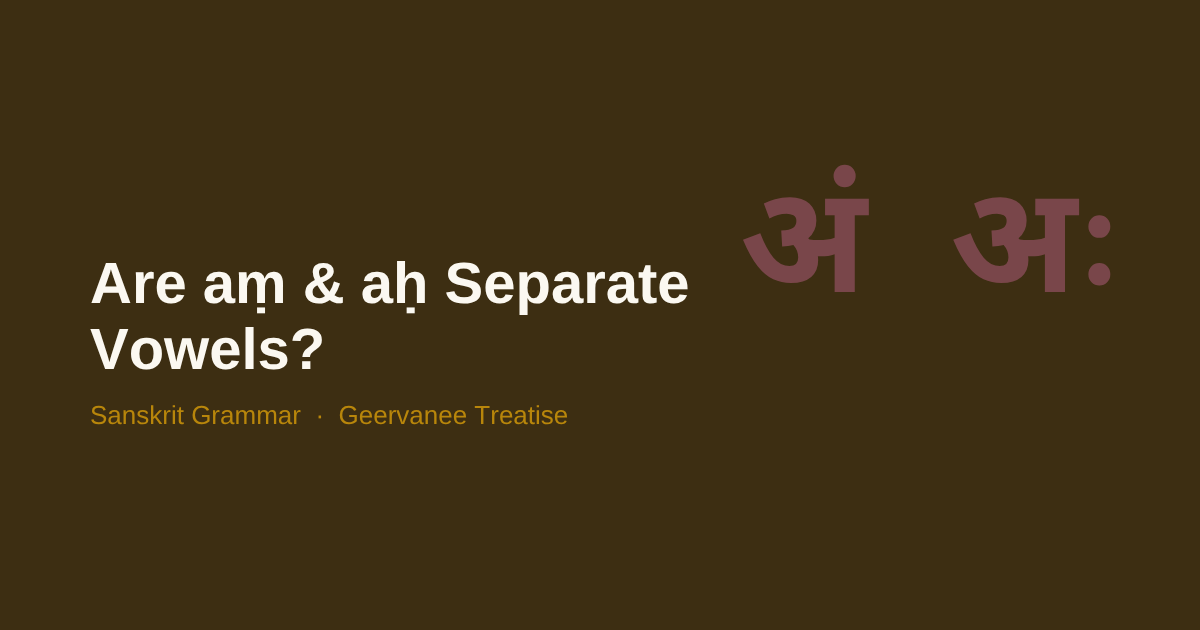
Are aṃ (अं) & aḥ (अः) Separate Vowels?

Many learners assume that अं (aṃ) and अः (aḥ) are independent vowels. But does traditional Vyākaraṇa-śāstra really support this idea? Let us explore this t…

P
Vyākaraṇavicāraḥ

Pāṇini's Ṇatvam Explained Through Physics

By G Gopala KrishnaResearch Scholar, Dept. of Vyākaraṇa, Karnataka Sanskrit University, Bengaluru A śāstram can be treated as a scripture, science, treatise,…

V
Vyākaraṇavicāraḥ

Vowels in Sanskrit

Namaste! Today, let’s explore the fascinating world of Sanskrit vowels (स्वराः or अचः), straight from Pāṇini — the true authority on Sanskrit grammar. Many say …

S
Saṃskṛtasampat

Significance of the Sanskrit Number System

Discover how Sanskrit scholars expressed vast numbers from ekam (1) to parārdham (10¹⁷) — the roots of the modern decimal system. Traditional Sa…

What Is the Geervanee Treatise?

The Geervanee Treatise is a running collection of essays on Sanskrit grammar, mythology, and language history — written in plain English for anyone curious about the language, not just students already enrolled in a course. Topics range from grammar deep-dives rooted in Pāṇini's Aṣṭādhyāyī (read the full text at ashtadhyayi.com) to everyday questions like whether Sanskrit is really as hard to learn as its reputation suggests.

"A wonderful way to learn Sanskrit. The teaching method is refreshingly innovative, and it builds real confidence."

— LN Srinivasan, Google review

Frequently Asked Questions About Learning Sanskrit

Is Sanskrit actually difficult to learn?

Not inherently — much of its reputation comes from how it's traditionally taught, not the language itself. Our essay debunking common Sanskrit myths walks through this in detail.

Do I need to know grammar before reading these essays?

No — the Treatise is written for general readers, not just students already deep in grammar study. Some essays go into Pāṇini's rules in detail, but each one explains the basics as it goes.

Where should a complete beginner start?

Start with Best Sanskrit Course for Beginners, then browse our Fundamentals-level courses when you're ready to move from reading to speaking.

Do I need to sign in to read the Treatise?

No — every article is fully readable without an account. You only need to sign in with your Geervanee ID to share an article or leave a comment.

How often are new essays added?

New essays are added regularly, covering grammar questions, language myths, and Sanskrit vocabulary — check the "Recent Posts" list in the sidebar for the latest.

↗ Share
💬 Comment

Comments

Sign in with your Geervanee ID to leave a comment →

Sign in to continue

Sign in with your Geervanee ID to share this article
Prefer phone verification? Sign in here →